Excuse my absence. Life, health and a new employer called.
I got into Digital Arts and Technology by chance, as a postgraduate, coming from a background of a Film and Commercials editor working mostly in the U.S.A. and the Near East.
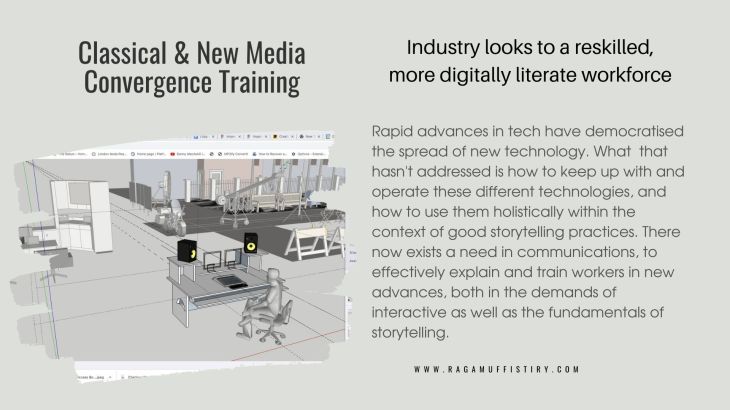
The main impact the master’s had on me, quite quickly as a film editor – linear storyteller – was how powerful factual information, like digital scene reconstruction, extracting satellite photogrammetry video, scraping for online time and date events, along with data from home built sensors, can be used to enhance legitimacy in reality storytelling, in whatever capacity, as activists, journalists or creators.
Flowcharting Linear v Nonlinear Stories
The main difference between new media and linear storytelling process lies firstly in interactivity. One of the primary benefits of using digital. Due to additional ‘drop in and drop out’ story structure points there is a need to be much clearer about layout and modelling.
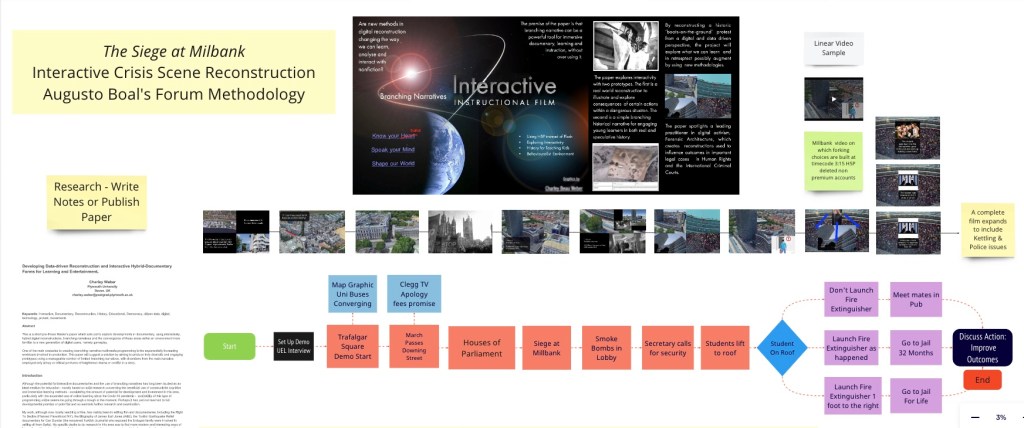
In figures 1 and 2 below are two flowcharts. First read the text and then, if you need to access the originals in higher resolution, double click the images on the Miro Boards. (Use mouse dial to zoom and right click to move page). No longer working from memory or linear storyboard and cards alone, the need for clear modelling of story and flow soon becomes apparent.
Modelling Linear Projects
Miro or Figma Jam Boards – the place to lay out all your project elements.

This traditional process for writing a book should not be too complicated and if you were prepping for a film you’d add visual storyboard scenes or shot sketches, or other illustrations, like animatics – if you’re an agency – or actual location shots, taken either personally or by accessing Google Earth images (which I use a lot. More on that and on extracting ‘flyover’ videos later).
Linear Story with Limited Added Interactivity
What happens to the flow charts of a story if we add a limited number of interactive narrative choices: towards the end of the chart are three choices based on the reality of the reconstruction and two other slight variations. Does the protagonist act with integrity and compassion, or perhaps disregards all of that? And what is the outcome of making one of those three story choices?
In the course I go over the advantages and disadvantages of analogue vs digital media, as well as examining the different software, like Miro, Photoshop, Premiere Pro and DaVinci, systems you will be using in the course.
However, I encourage anyone interested in modern approaches to storytelling and this kind of work to sign up and explore the Miro and Figma Jam boards and explore the different processes for modelling different media, like prototyping for apps and websites, storyboarding film and interactive systems, which you can do with a free account.
Note: For anyone interested, there are all kinds of creative and technical areas where practitioners can work in training, mentoring or assessing apprentices. Searchable if you click on The Institute for Apprenticeships. We generally work under an associates contract with the creative media assessment organisations. The pay is not bad, but it does fluctuate seasonally.
 Charley Weber Portfolio
Leave a Reply