Turkey: ISTANBUL
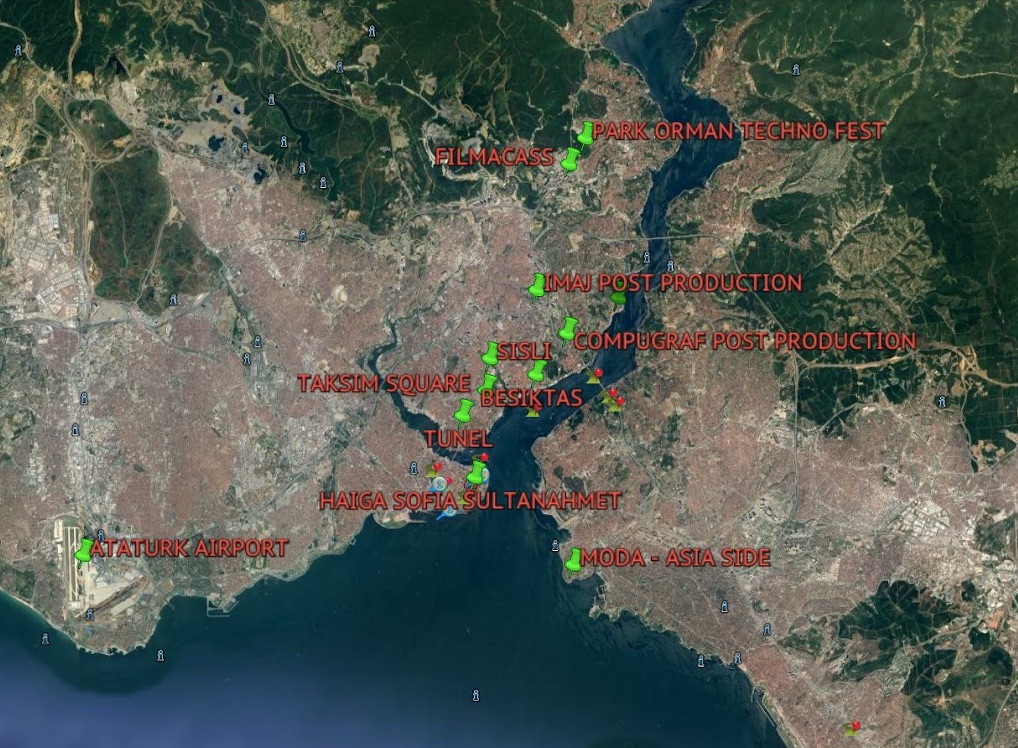
I lived and worked in Istanbul for nearly a decade. A list of some of the key sites and areas a visiting traveller or film freelancer should explore, in my opinion, include:
- Taksim or Beyoğlu, including the Galata Tower, Galatasaray & the Tünel.
- Sultanahmet – Hagia Sophia and the Basilica of Roman Water Cistern.
- The Princes’ Islands, of which the main one is Büyükada, to which you can catch a ferry ride from terminals in Beşiktaş.
Perhaps surprisingly, my most memorable experiences as a place to live and work I found to be Istanbul, Turkey. Although Bulgaria may feel more natural to a European, finding work there can be incredibly difficult, as I found when I got stuck outside the border on a new visa regulation and spent six amazing but extremely cash-strapped months there. More on Bulgaria later.
Generally speaking Turks are a hard-working bunch and their relationships tend to run slightly deeper than in the big western cities, although there are trade offs. The creative economy is functional, as it’s a large agency funded media market. But when I was there it had its ups and downs – from one political scandal to the next – so a freelancer may well need backup gigs, like voiceovers or a serious English teaching certificate.
As a note, some of the agency fed commercials production companies have changed since I left at the end of the noughties. However it does seem most of the main ones have stuck around and grown.
Imaj still seems to be the main player. A huge tv and post production company, the size and equipment list of which may surprise English and American film workers. It is huge and the equipment is shockingly state of the art; part government funded to keep Istanbul firmly on the production map for international, but increasingly for a burgeoning Turkish film, documentary, tv and commercials market. The latter of which is fed by sizeable and respectable agency budgets from the likes of Proctor, Saatchi’s and the usual international brand owned companies.
Filma-Cass is an established high-end film and commercials production company. Their outstanding feature films probably still are Eşkıya (The Bandit) and Her Şey Çok GüzelOlacak (It will be very nice). From Filma-Cass I probably got most of my freelance work after being hired as a full-time editor for Compugraph, another post production shop for whom I edited a large number of commercials. Filma-Cass has relocated from midtown to a new business and production centre in the north of Istanbul, Esentepe, where most of the production companies have or rent large studio stages, because of lower real estate costs.
A good place to start, from a film creative’s point of view, may be visiting the London Turkish Film Festival site, which has showcased a history of some of Turkey’s best filmmakers. They might include Fatih Akin and Reha Erdem – his Kac Para or How much Money, is a universal tale, lean, clean and tight filmmaking.
For me, as a Gen Xer, Turkey was a great antidote to seven years working as a freelance editor in NY, where I was initially signed as a producer/director, but became sidelined into editing and subsequently hit a bit of a personal career ceiling.
After having spent several years working on immigrating to the U.S.A., my girlfriend who was Turkish but NYIT educated, and with whom I had applied for and won a US green card after seven years working on a business visa in the U.S.A, was horrified at the idea of moving back to Turkey. Her parents though, who visited us in New York, were thrilled at the prospect of having their daughter close to home again. More on that and NY later.
The production companies servicing the localised agency franchises, like Saatchi, Ogilvy or Grey, also produce feature films directed by their own in-house directors. The challenge with editing feature films in a foreign market such as Istanbul is that you really have to master the language to a level of understanding subtext, which is the unspoken lifeblood of most decent films, of which there are now many made in Turkey. Fortunately this is not the case for editing commercials, where there are good budgets, simple, translated storyboards and not a lot of subtle nuance or subtext involved beyond selling baked beans or toilet paper, which is pretty much the same everywhere. The roles you can offer the market include editing, writing, compositing and creating special effects, music and an array of support services.
Companies I worked for in Istanbul as a commercials editor, like Filma-Cass, Plato or IFR, usually brought me in as an English speaking editor to make communication easier with visiting English, European or North American directors. The production companies would then make packages and pitch to the advertising agencies.
Surprisingly to me, freelance rates were not that dissimilar to the rates in NYC, London and L.A.
Based on my experience I would say yes, this is a wonderful place to look into, to visit, to work or to live, especially if you receive an offer from overseas, but you’ll need an unusually strong CV to get one of those. Best to try for one of the major players like Imaj or possibly 1000 Volt.
If you are willing to put in a few months you’ll be able to get a feeling of what it’s really like to live in Istanbul. The people, history, food, culture and architecture are usually mesmerizing to a westerner and the open and genuine nature of most Turks often leads to more than a few life-changing friendships or work relationships.
The main difference nowadays is that, whereas in the production environment of the past it was a big bonus to have a westerner or former BBC trained freelancer as part of the team, the native production community is now well developed, maybe better than in the west. So they do now have a production pool of their own talent.
I left and returned to Istanbul a number of times. I left to edit a spec script, Reverb, in London and then to edit a feature film called Swing, in Los Angeles. On my third return to Istanbul, after journalism school in London, I recorded a series of interviews about the Gezi protests, which I’ve yet to produce. I finally left at the end of 2016, after the coup, with the impending clampdown on freedom of expression.
In retrospect, how did it pan out? Being on the outside, it is hard to gauge online, it does seem to have affected foreigners less than native academics and journalists. Having said that, a number of the top journalists I worked with, like Can Dündar, for whom I edited the Saatchi & Saatchi’s Earthquake Relief documentary, were subsequently arrested and then fled as exiles to Germany.
But as most western citizens can sympathise with the wars in Europe and the Middle East, during any period of heightened security, everywhere has additional state and self censorship, it seems to depend on how populist the politics and whatever wars the local governments back or are involved in; how genuinely leaders embrace the media and politics of those conflicts to justify their own existence. However, that is a global issue and although censorship is more extreme than in most European countries, it is one on which we mostly all tread some kind of line to stay on the right side of, whether for work or posting online.
 Charley Weber Portfolio
Leave a Reply