Book 2 – Extract from a new book: Travelling Freelancer.
Note: Revised Edit for Grammar on 30-03-2026. This is my writer’s pre-edited chapter version.
It might benefit from an outside editor’s perspective, although I can probably work through it to clear up any glaring errors.
In the lead-up to the millennial celebrations in Istanbul.
I flew out from Edinburgh to meet my former New York production partner, Ates, for the opening of a new club he and his sister were opening in Bodrum called Lush Life.
He picked me up from the airport, and drove me to the site, which although a little bizarrely located behind a gas station a few miles outside of the main town, had a pool and latticed steps for soft furnishing cushion areas surrounded by flowerbeds, with a handful of Kurdish gardeners working feverishly to apply the last minute landscaping touches to what under moonlight would hopefully transform into a late nineties clubland paradise. It all looked a bit naked in the daylight, but a nice change from Springtime in Edinburgh. He told me of the talent they’d contracted for the opening party, which was the following day, when a DJ and a couple of dancers would be flying in from France from a talent agency of a very cool DJ called Bob Sinclar, who they’d brought over to perform at one of their clubs in Istanbul. After which he drove me to meet his sister and family around the pool of a beautiful villa with views overlooking the Sea. After cocktails and some nibbles, I checked into a nearby small hotel, there being no rooms left at the main house.
The children of a middle to upper-class Turkish family, their father was a submarine commander, who apparently outwitted Western boats in a NATO military exercise. He, along with his older sister Alev, who had recently resigned her position as the CEO of a leading medical company in Turkey to join her brother in what was then a booming entertainment environment in Turkey. Her younger brother, Ates or ‘Titan Turk’, had been a production and post-production partner in New York, where we’d both worked together as producers for the same production company, ANS. Although we’d worked our asses off, we’d become disillusioned with the owner, who took all the directing gigs and left most of the creative talent to handle the less creative aspects of producing commercials in New York. So at some point, we invested in a new Avid non-linear editing system. While I tried to make the Avid editing system create a profit, not being an editor, Ates returned to Istanbul to try and pitch and produce shows for the recently privatised Turkish TV industry – formerly state-owned media, TRT – he’d managed to get one produced, called Chaos (Karambol). However, it seems the brother and sister team had quickly redirected their focus to DJ-based electronic dance clubs, the demand for which at that time was through the roof. Although a Berkeley-educated Jazz drummer, Ates had discovered that, while promoting live Jazz gigs with his mates – most were also accomplished musicians and Berkeley graduates – when he switched to mainly electronic DJ sets with live or Jazz accompaniment, people flocked to his shows. This soon led to the opening of their first dance club in Istanbul, then another called Switch and finally a third, which they were opening in the holiday resort of Bodrum.
The opening of their new club, Lush Life brought to mind Ibiza in both music and culture, but exported to Turkey. I both knew and admired Ibizan counterculture. About three years into my NY experiment, being overwhelmed by immersion in American TV and culture and missing Europe, although I didn’t yet have my green card, I risked leaving the country, for what I thought was a short holiday and spent six months immersed in a hippy area in the North of the Island. I say hippy, by that point the community consisted not just of travellers, but documentary and exposé news filmmakers, musicians and artists and, as well as the usual assortment of escapees from the rat race, addicts, hippies and dealers: all part of the community fabric at the Northern end of the island.
Although at the time, my Ibizan escape had worried my then production partner, on the journey to the event, he said he now understood why I’d stayed for so long, as Ibizan seemed like the new and wide open future, especially in music and the one on which he and his sister were basing their music and activity in clubs around.
For the club opening, they had flown over a famous French DJ and two dancers, along with whom came a somewhat difficult manager, Jean Phillip, who I would later have to deal with at length to negotiate contracts to bring over other artists, including Pills, a leading electronic band from France. The outdoor club was mainly lit by low-level garden lights and brighter light coming from the pool. Sitting next to Alev on soft cushions, I watched the proceedings as the Bodrum crowd floated in and danced, ate capes, tasted the drinks and took in the atmosphere beneath the stars. Until finally I was unable to resist the temptation to be the first to dive into the inviting pool, having spent a year in Scotland and the UK, coming out of winter, it was a welcome physical and symbolic dive into what I hoped would be chilled but easy-going and refreshing experiences in Turkey.
When the opening night was over, I caught a cab home, and we each made our way separately to Istanbul. My then wife had flown in ahead of me from NY, and when I arrived, she had booked me a room in an old terraced building full of Erasmus students in Harbiye, close to the centre of town near Taksim Square or Beyoglu. She visited me usually in the morning on her way to work as a programming acquisition producer for a cartoon and children’s film distribution company in Istanbul. Although, because of my delay in reaching Istanbul, although we had gotten on famously when they had visited New York, I was now persona non grata with her family, who promised to cut her off in her will or at least, not allow her ownership of a second house they owned and had promised us if we came to Istanbul, which was something that she was not keen on and a move that I and her family had talked her into over a roof top barbecue dinner at my place in New York.
All of this was going through my head and I was still reflecting on what I’d done, by staying or getting stuck in the UK for what was now nearly a year, when having only been in Istanbul a few days, I decided to call my friends, the sister and brother team from HIP productions, to seek advice on where to start enquiring about film work opportunities in Istanbul.
When Alev answered the phone, she seemed pleased to hear from me, and so I thanked her for the Lush Life experience and asked her if she thought the opening boded well for their small but fun piece of Ibiza in Bodrum. She explained that it had gone as well as could be expected, but they’d have to wait and see. I explained I was looking to come in and chat to pick their brains for film and editing contacts in the city. She then asked me to come in to meet the next day, which I did.
The HIP production company office was situated in Arnavutkoy, a picturesque seafront neighbourhood located along the Bosporus, known for classical Ottoman wooden architecture and buildings. Walking along the seafront, tied up with motor yachts and boats interspersed with locals out fishing and enjoying the sun and catching fish for dinner, mostly Mackerel, the town of Arnavutkoy had a couple of upscale seafood restaurants, a bakal or delicatessen and a toast shop. I made my way to the offices.
When I rang the bell, Alev answered with a warm welcome. Great hospitality, if I hadn’t already met them, you could definitely tell she was from a good family. She offered me water, coffee or tea and asked me to join her as she sat behind her desk.
As I thanked her for the Lush Life experience and began to ask about film and post-production companies in the area, if there could be any of their associates who might need an experienced Avid editor, she interrupted me.
‘Funny you should say that, as the reason I asked you here today is to discuss a work proposition we have for you.’.
Taken aback, thinking to myself, ‘Surely it can’t be this easy’. I asked her to continue and explain what she had in mind, not wanting to interrupt wherever the conversation was leading.
It turned out, busy as they were running a couple of seemingly popular electronic music clubs, they had been planning something much more ambitious and had managed to secure sponsorship for the first-ever large-scale 24-hour electronic music festival to be held in Istanbul, from Seagrams, or more specifically, its parent company, United Distillers. The team at HIP had been busy. Alev explained that her current major production backlog was that although the event had been scheduled for within just three months, in late September, they had so far not booked any of the artists from what was promised to the sponsors as an international roster of top electronic acts, artists and DJs. Turkish time was running out and what they really needed was an English-speaking agent or representative to negotiate the contract, fees and terms with the mainly international artist and their agents.
We agreed on a fee which, although less than I earned as my day rate working in film, as Alev said, was generous for Turkey. I did some quick mental arithmetic on the conversion rate and my living expenses, and without checking, I took her word for the offer being reasonable and agreed. What an incredible project and opportunity. I’d come for a few leads and walked out with a contract to work for the next three months.
After this, as a family friend, Alev invited me for a trip to visit Moda, where she lived. More specifically, to their Beach Club, a shishi social and swimming club located next to their apartment in Moda, where the educated and wealthy still enjoyed the good life. Moda, being historically the most desirable district of Istanbul located on the Asian side of the Bosphorus.
On the trip over the main bridge, we engaged in small talk about how she’d made the seemingly huge and brave leap from being the CEO of a medical company to the head of a much smaller, but promising, new Istanbul entertainment company. I then asked about the human rights issues in Turkey, whether they were also changing. Alev said it was a huge problem: ‘the students and human rights activists keep throwing themselves up against the state and getting locked up by the authorities’. She then asked me about my impressions of Istanbul and how I was adjusting. I was definitely experiencing a certain amount of culture shock. The city was incredibly busy with people and cars cutting much closer to personal space than in Europe or the States. She laughed and said I would adjust in time, but that yes, to cross the road in Turkey, you had to some degree throw or insert yourself into oncoming traffic, but that they will make way for you. I agreed to take it easy on how far I’d venture until I got used to the level of stimulus, or what my friend Ates called a readjusted ‘Beyoglu Radar’.
Alev said we would need to start chasing artists asap, so we set a date to start to begin work in a few days hence. The wish list of artists was handed to me and curated by her younger brother Ates. The first band on Ates’ list was for Run DMC, which surprised me, although I had met Aerosmith’s management in London, and had heard ‘Walk This Way’ enough to know they were a slightly open, interesting pioneers and slightly fusion rap outfit. Although he’d always been a huge fan of hip hop, since working together in New York, I’d become quite close to him and his wife, Sarah, often visiting their place in the old jazz club area of New York. But being essentially a jazz drummer, Ates had become familiar with the leading international DJs and electronic acts while operating clubs with his sister.
It was all very well saying I could handle the job offer, but how exactly would I approach the music contracting thing?
The negotiation process for engaging the artists through their managers turned out to be something I could learn fairly quickly. It was like a game of poker. You’d pitch the managers on whether their particular artists, 808 State or Aphex Twin, or Adam F, might like to join us in Istanbul for the first-ever Creamfield-type multistage 24-hour event to be held in Istanbul? They usually responded either positively or with something like ‘Well Charley, let me talk to the boys, see what they say and get back to you on this over the next couple of days.’.
It turned out to be a game of bluff. The skill or knack, as I began to discern, was to gauge from the agents reaction how much they or the artists wanted to be a part of our festival, and then adjust the offer accordingly: higher if the act was a priority and they needed persuading, lower if it sounded like they’d pretty much do it for free, as long as they could be a part of the line-up. In that way I was able to secure some of the bigger name acts, like Adam-F, who’d just released a seminal Drum ‘n’ Bass album, who had a huge live band, for a few thousand dollars, whereas for a few of the other acts we had to push the performance fee up to around and just over five figures, to $12,000.
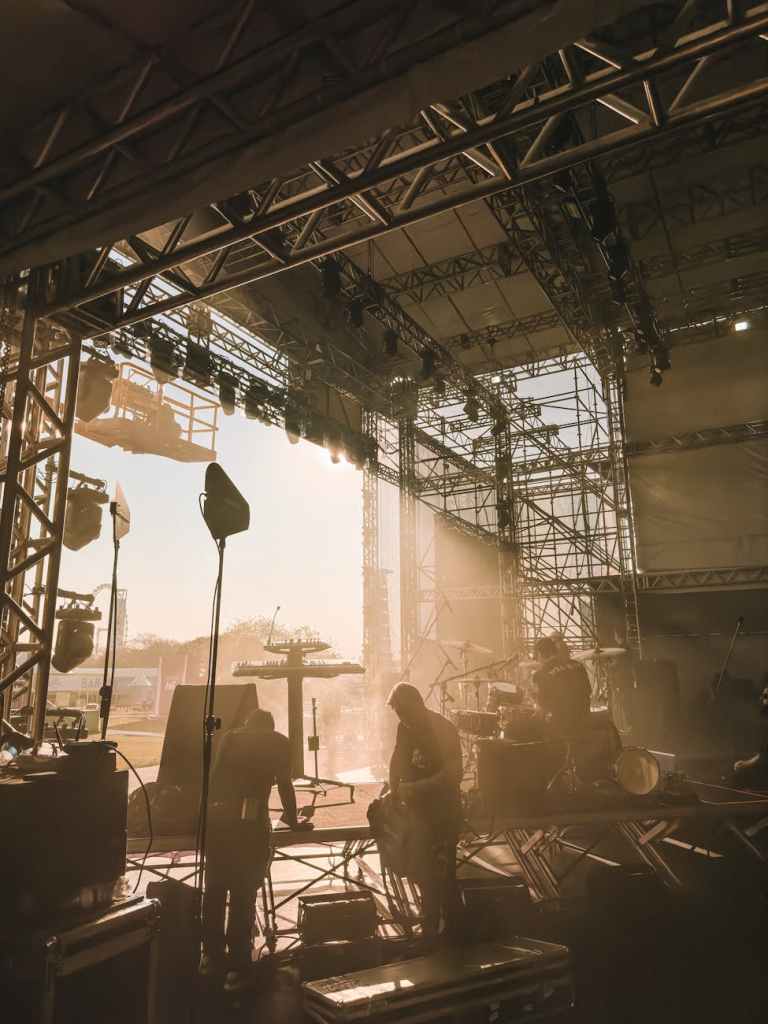
To be honest, it wasn’t a difficult sell. The bands would get to perform and spend several days in one of the coolest and most exciting sunny cities in the world, while being put up in a 5-Star hotel. The festival had two stages, located around a 2,000 square meter pool, a main stage to the front of it for the live acts, and an amphitheatre off to the right for the DJ sets. It had a bungee jumping installation and a Levi ’s-sponsored skateboarding ramp. And all of this was located in a forested nature reserve area, called Park Orman.
Although there were jazz and rock festivals, produced by Acik, a local record and production company that, according to them, had taught Ates and HIP all about electronic music, nothing like this in Electronic music had ever been attempted before.
In addition to the main sponsor, an important part of the festival promotions was the media sponsors. One of which was Radio 2021, which we could use to promote the project through music and later to film the actual event live on a television channel called Kannal D. In return for branding on signage, along with exclusive access, they agreed to promote and broadcast the event leading up to and during the festival.
In the first week or so at work, Alev handed me a number of contacts for the English-speaking press in Turkey, as the office would be handling the Turkish press and media. The first and foremost of which was ‘Mad Molly’, an Irish editor of the English Daily News Newspaper in Turkey; introduced me to Gamze Derinkok, the sponsorship agent for United Distillers in Turkey, who took us all out to Pasha on the waterfront in Istanbul, to witness a live music event they were sponsoring featuring a headlining dance vocalist they had brought over from the USA. It was a way to understand the number and scope of the Seagrams branding they were looking for, as well as a way to get to know each other in a more project-specific setting outside of the office and work.
On the artists and agenting front, I began making progress, although my first call to Run DMC was declined, the agents didn’t understand the appeal of Hip Hop to a Turkish audience, and the fulfillments of most of the rest of the provisional artists and DJ contracts were falling into place. All of their contracts had payment schedules which had time-critical fulfillments for advance payments: mostly 50% up front and the rest on completion of their performance. I had managed to secure commitments from most of Ates’ wishlist, including 808 State, Pills and the Propellerheads, as well as Aphex Twin’s Reflex DJ crew, and DJ GreenDay. Apart from the French agent who’d sent over the DJs and dancers for the Lush Life, who was playing games and proving difficult to deal with, he represented a semi-headlining electronic act, at that time one of the most popular around, called Pills, as well as another DJ. However, their two artists could not be seated together or on the same plane, as they would fight, and this had caused problems in the past. A lot of the manager’s behaviour sounded to me like a prima donna; it was all play for attention, a need to be special because he obviously didn’t feel that way. I bit my tongue and spent most of my time on the phone with his secretary, the poor thing, who had to fend off callers, played a long as best I could, until one day I lost it and vented my frustration at what a basket case of psychological issues all of his attention-seeking behaviour had brought to mind.
The English-speaking paper, Turkish Daily News, headed up by Mad Molley, as Alev had implied, by rolling her eyes and laughing when mentioning her name, was indeed a colourful character. However, Molly responded to the call I put in for the festival and asked for an interview, which I agreed to, and we met up in a Beyoglu night spot called The Secret Garden. There with her reporter friend Ali, also an electronic music fan. He was so impressed by what he saw as the cultural significance of the change that this event would bring to the city and country. This new friendship resulted in a two-page spread in Turkish Daily News, hailed the organisers as people the country ought to be building statues of, for staging such a bold and dynamic festival embracing cultural change.
After a party to announce Molly stepping down as editor of Turkish Daily News to launch her PR company, this resulted in me moving out of my Erasmus single room post-grad lodgings into one of Mad Molly’s larger artist studios in Tunel.
No doubt largely because of the publicity inroads HIP office was making into Turkish media, the word on the street about this oddball festival began to spread pretty quickly. Until, at a certain point, if you walked around Beyoglu, you could even see old men sipping tea, tossing their worry beads, and muttering about the J&B Dance & electronic festival. It was surreal, and after a lifetime working in entertainment, film and music, like nothing I’d ever experienced.
After talking to the English newspapers, Radio promotions with Radio 2019 and a DJ friend of HIPs called Roxanne were both educational and a lot of fun. Although your instinct is to throw your best artists first, to have the biggest impact, new systems take time to figure out any problems, weaknesses, or flaws. Whereas Roxanne was a popular DJ and spoke English, as it turned out, she was not a natural on-air artist interviewer. This became apparent as soon as one of the UK electronic groups was live on air. Fortunately, the band that I was most excited about, Bentley Rhythm Ace, were relatively new and, although making waves at electronic festivals in Europe, was not yet a big deal internationally. We had forgotten the most important part in the communications equation, outside of playing records, were the people involved, broadcast communicators. On the first time out, there was a lot of awkward silence, not enough research and too much dead air. However, on the second try, we ourselves went along for a live interview with the station, which was much more spontaneous, and broke the ice between the bands, the station and its listeners. After setting a precedent for a tone, vibe and flow, the subsequent on-air artist interviews fell into place much more naturally.
Due to the success of my PR efforts in contacting Turkish Daily News, the English national newspaper, I was encouraged to take on other English language media and communications work, like building English language festival kits, scheduling on-air radio artist interviews with Radio 2019 and making ads. This as well as my contracting role, although I didn’t have communication with the senior boss at United Distillers (J&B) Turkey, as he didn’t speak English, as the sponsors said they were still waiting on transfer of sponsorship funds from United Distillers International, and so increasingly spending my time on calls trying to keep the artists on board and reassuring Gamze Derinkok, the Sponsorship producer at United Distillers. That they were late making their first big payment to enable HIP to fulfil its commitments for the initial round of artists’ payments and then upgrade the provisional contracts for full contracts, which would trigger sending things like rider requests.
The big boss at United Distillers, was older than Gamze and the HIP, a little more conservative and less open to change and was nervous, about whether this unconventional outfit was going to embarrass them, United Distillers and I suspect Alev, asked for a sponsorship production team meeting, on-site by the pool in Park Orman where the main stage was going to be built, at which we were all to be wearing J&B branded t shirts. To my embarrassment afterwards, it was because of vanity I didn’t wear one that day, although not out of a desire not to fall into line as one of the team, but because they weren’t very flattering t-shirts and poorly cut. Although in retrospect it was the least I could have done, and was something I regretted afterwards.
Although United Distillers by then had missed the first payment date by a moonlight mile, which had left a good few of the managers turning against me saying they’d have to pull out, and that they were not happy at all about the promises not being kept, as they’d had to turn down other work etc, when finally HIP productions received the first payment from United Distillers, most of the artists agreed to rejoin once we’d sent the first payment.
As the tempo of the build up to the festival and the media frenzy grew to a fever pitch in the office, with the phones ringing off the hook, which by that point we had to ignore to get anything done, I had completed the festival media and artist kits when the artist volunteer guides were brought in to the office and given explicit instructions as to important parts of the manual to read out loud let each of the artists know that, if they were caught with any illegal substances or other contraband they would be on their own.
On the day of the festival itself, the streets that part of Istanbul were all jammed, as way more people than we’d imagined tried to reach the festival in time for the start of Istanbul’s first ever 24 hours of performances of eight of the world’s leading electronic acts and fourteen of Turkeys and top international DJs from around the world converged on Park Orman at the North end of the Bosphorus.
In fact, there were no arrests, and only one minor first aid injury, even though apparently, almost all the acts were high on their own pills. What happened the day after the festival was a huge stream of congratulatory faxes came through to the office from the major Turkish Entertainment companies, like Sony, BMG, as well as the sponsors, J&B. All of whom at some point had thought we were certifiably crazy to try to stage an electronic 24-hour festival in Istanbul.
 Charley Weber Portfolio
Leave a Reply